Action-conditioned world models are useful for embodied agents only when their predicted futures remain controllable by actions and stable under long-horizon rollout. We present SAMPO++, an embodied world model that treats action-conditioned prediction as a scale-decoupled controlled dynamical system rather than as conventional action-conditioned video generation. SAMPO++ couples temporal autoregression with scale-wise flow matching in a continuous latent pyramid. A multi-scale temporal planner summarizes the latent history with scale-matched recurrent states, allowing dynamics at different resolutions to be conditioned by appropriate temporal contexts. An Action-Controlled Velocity Field (ACVF) separates action-free passive drift from action-induced residual dynamics, making the action an explicit bounded control input to the flow velocity instead of a passive conditioning token. To improve cross-scale consistency and closed-loop stability, SAMPO++ further uses Pyramid-Consistent RoPE (PC-RoPE) and rollout-aware training, aligning scale-wise coordinates and exposing the model to its own autoregressive prediction distribution during training. Beyond standard perceptual metrics such as FVD, PSNR, SSIM, and LPIPS, we evaluate world-model-native properties including action alignment, counterfactual accuracy, no-op stability, and rollout drift. We further study SAMPO++ as a learned controllable simulator for policy evaluation, action-sequence ranking, and model-based planning, where candidate policies can be rolled out and compared before execution. Experiments on robotic manipulation, autonomous driving, visual planning, and model-based reinforcement learning show that SAMPO++ improves both visual prediction quality and action-controllable long-horizon stability over strong discrete and continuous baselines.
TL;DR
SAMPO++ turns action-conditioned world modeling into a continuous Predict-then-Refine process, preserving autoregressive structure while synthesizing high-fidelity long-horizon futures.
Temporal structure
A planner first predicts coarse future priors so downstream rendering keeps causal dynamics coherent.
Scale-wise refinement
Flow matching refines future states from coarse to fine scales directly on continuous latent manifolds.
Action fidelity
ACVF and PC-RoPE improve controllability, cross-scale consistency, and closed-loop stability over long rollouts.
Conceptual comparison and framework overview.
SAMPO++ resolves the trade-off between discrete autoregressive reasoning and continuous synthesis through a unified Predict-then-Refine paradigm.
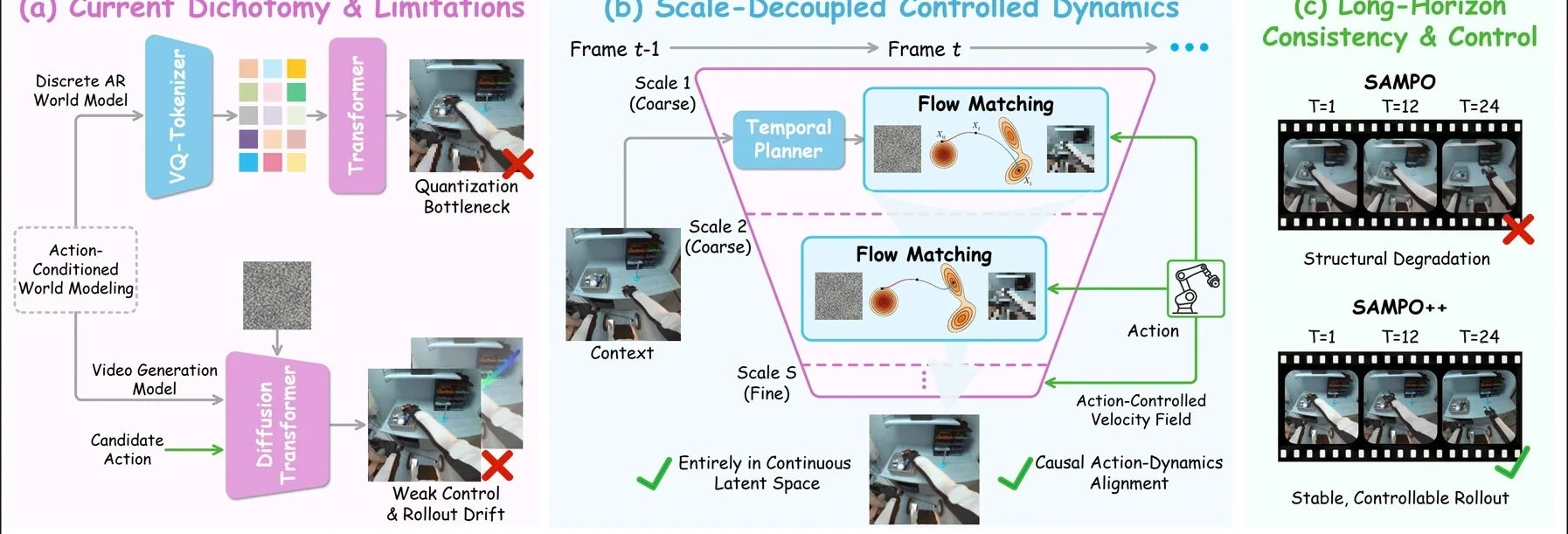
Conceptual comparison and framework overview
Current dichotomy: discrete AR models suffer from quantization artifacts, while standard continuous models are restricted to fixed-length synthesis. SAMPO++ solution: temporal autoregression and scale-wise flow matching are unified on continuous latent pyramids with explicit action-controlled velocity fields. Performance: the resulting model improves long-term coherence and action fidelity.
Method
The model separates future structure prediction from visual detail synthesis, then binds both stages with action-aware modulation.
Future observations are represented without discrete token bottlenecks.
Temporal priors preserve causal and long-horizon state structure.
Future latents are refined scale by scale for high-fidelity details.
ACVF, PC-RoPE, and rollout-aware training improve controllability and reduce rollout drift.
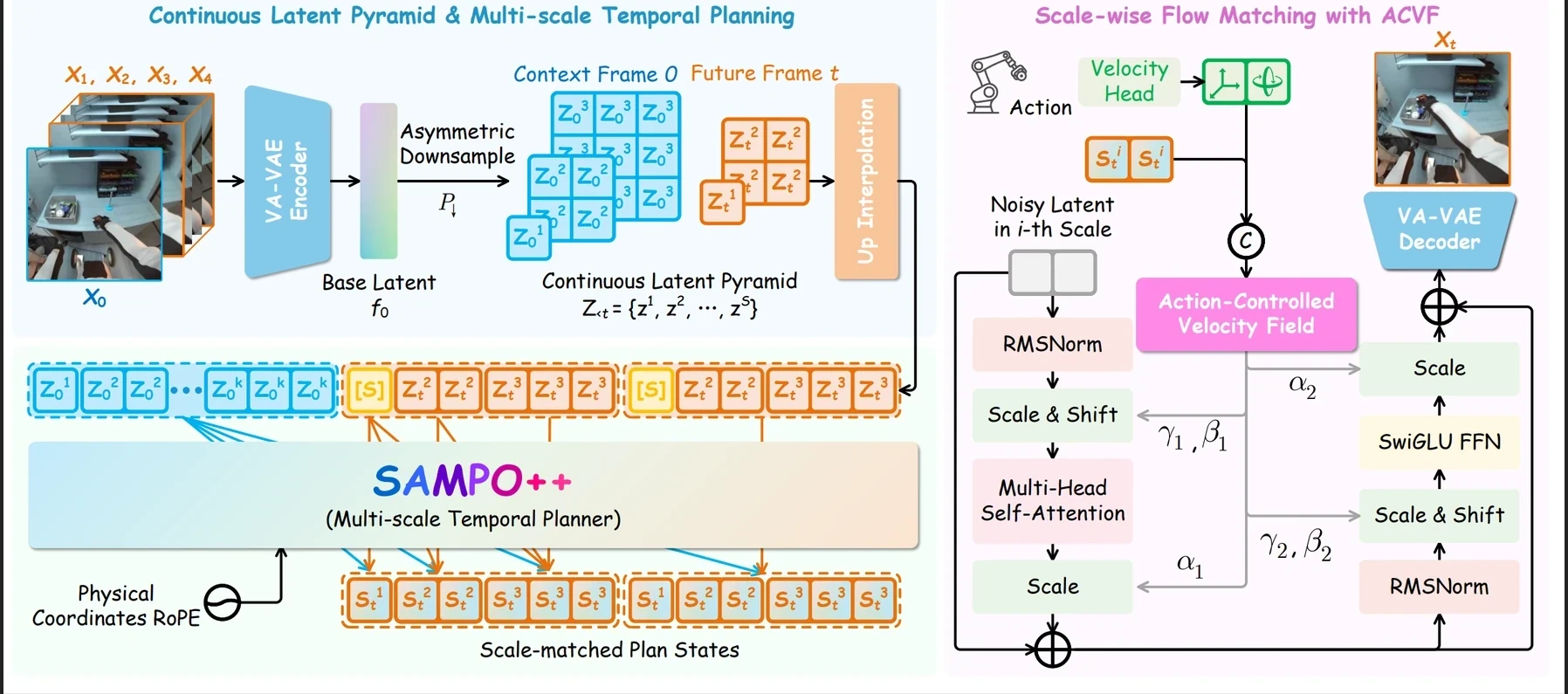
SAMPO++ overview
A temporal autoregressive planner predicts structural future priors; a scale-wise flow renderer synthesizes high-fidelity future latent states.
Visual results
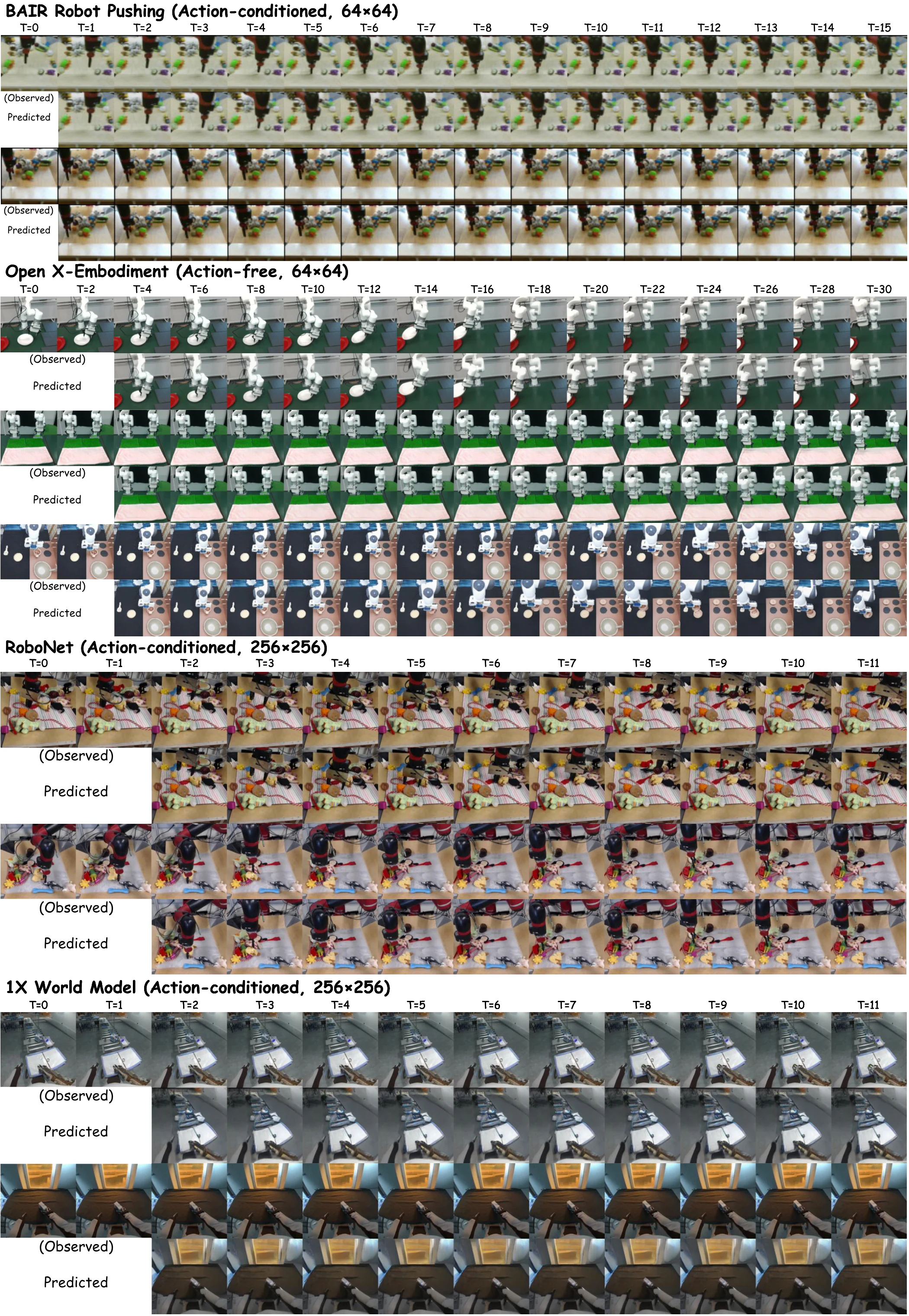
Qualitative results cover robotic manipulation, autonomous driving scenes, visual planning, and Meta-World control, showing coherent dynamics under action-conditioned generation.
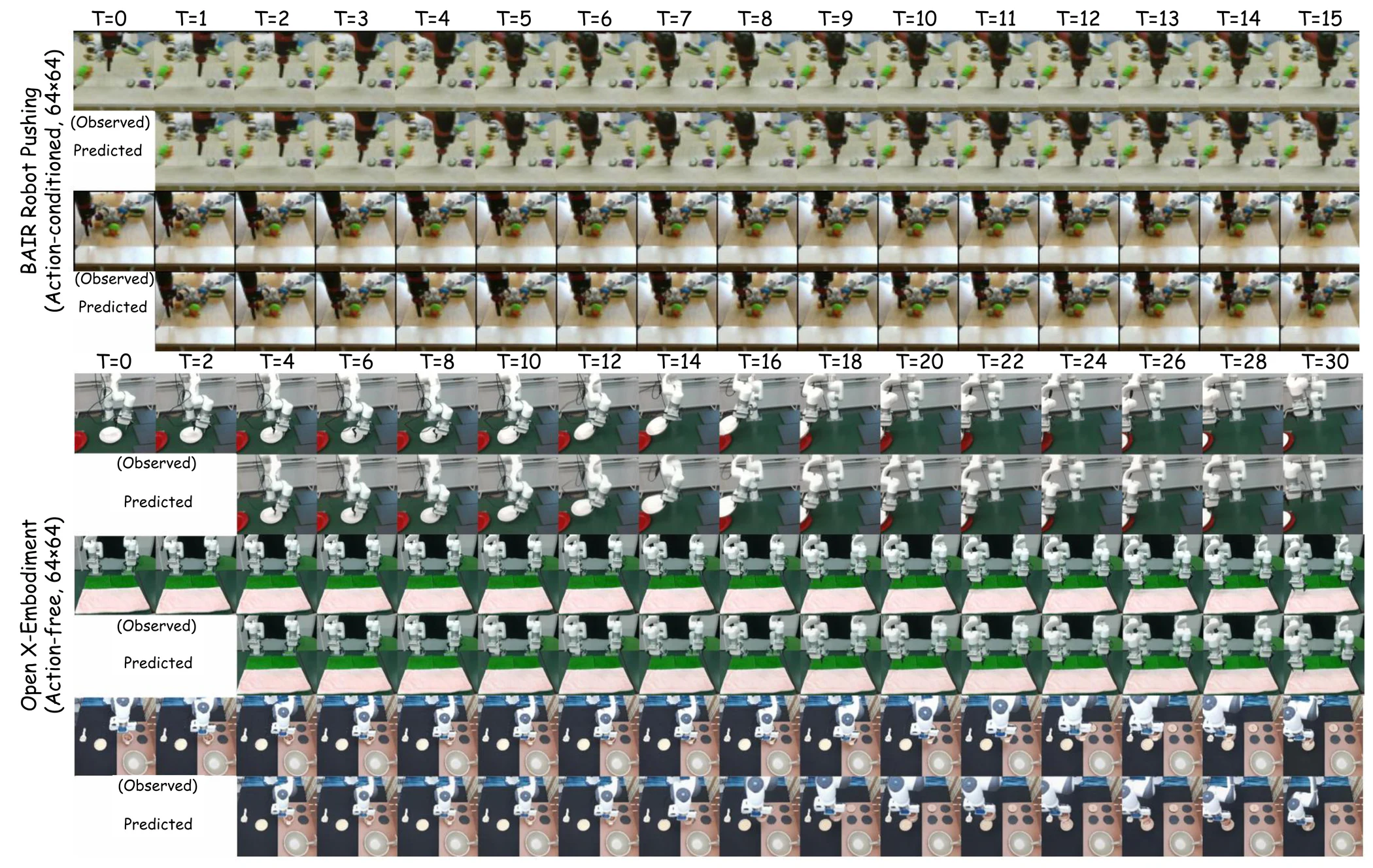
BAIR and OpenX-Embodiment
Future frames preserve object structure and manipulation dynamics.
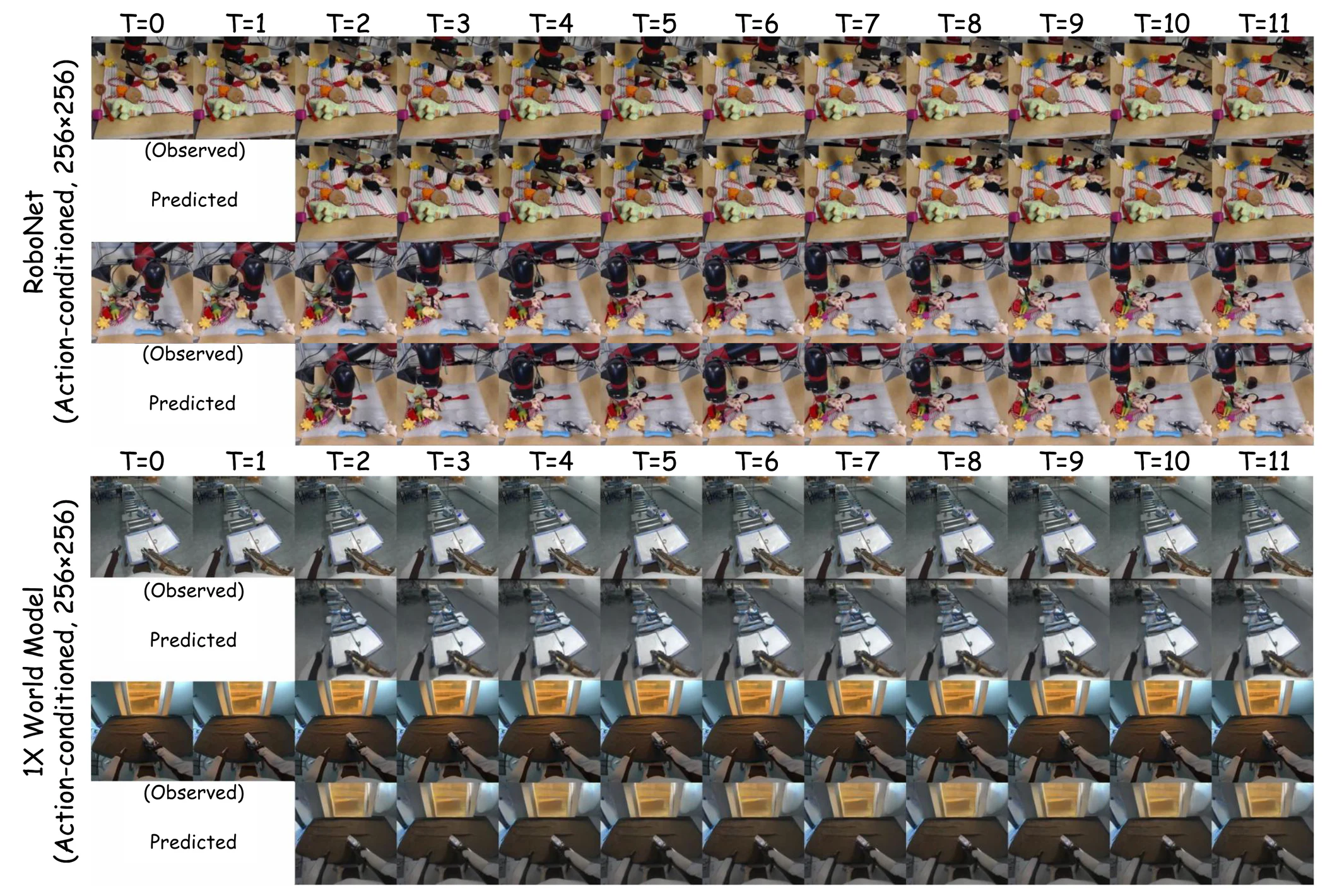
RoboNet and 1X World Model
Higher-resolution prediction shows detailed action-conditioned synthesis.
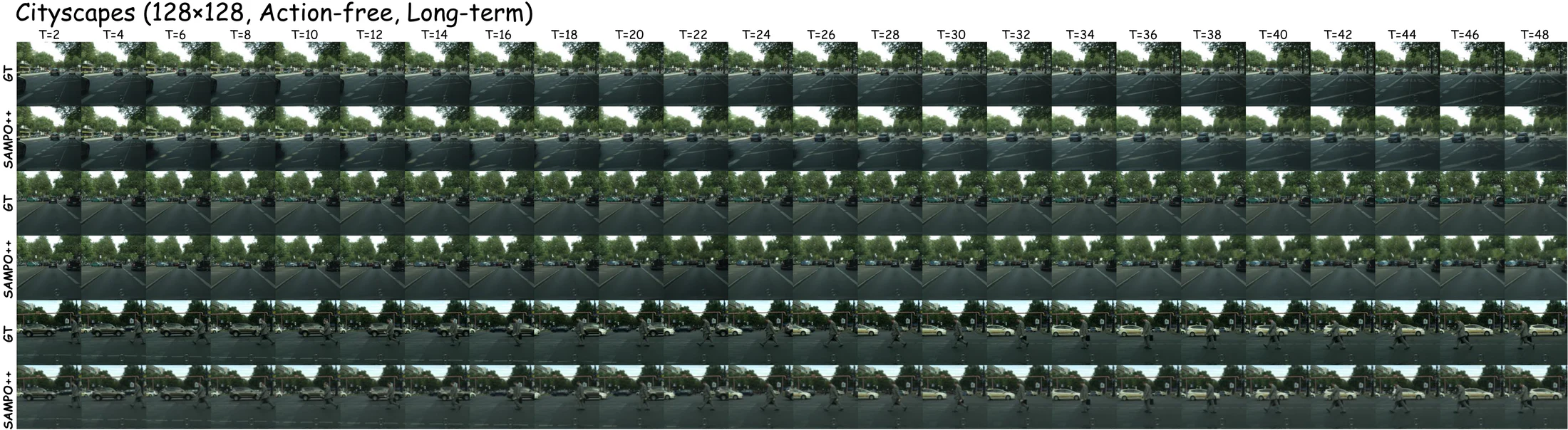
Cityscapes
Driving scenarios remain spatially coherent over long-horizon prediction.
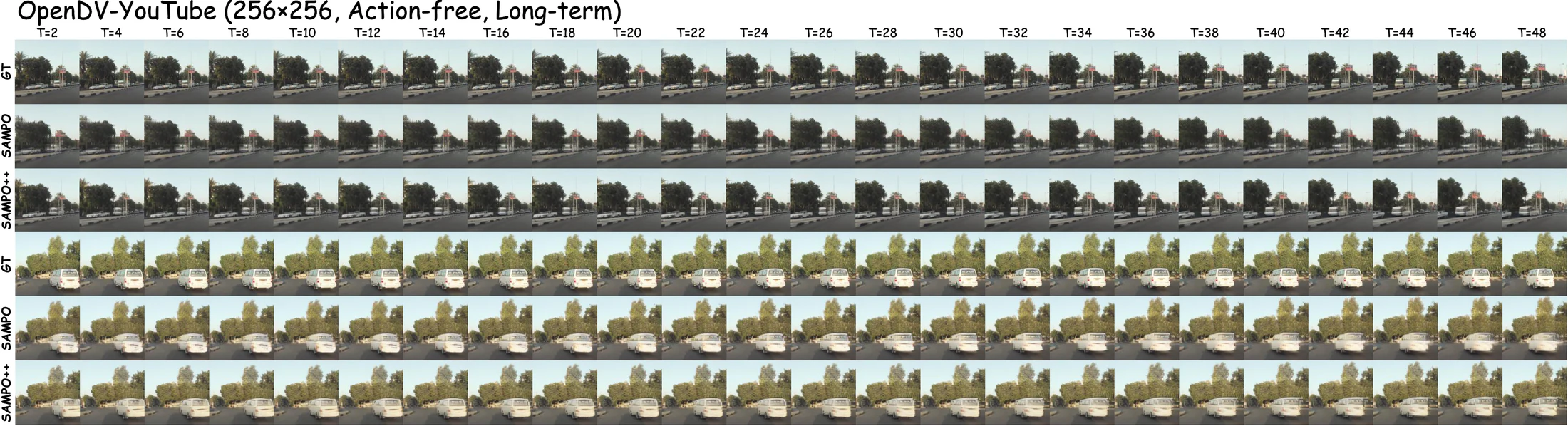
OpenDV-YouTube
In-the-wild driving scenes retain robust dynamics and resist artifacts.
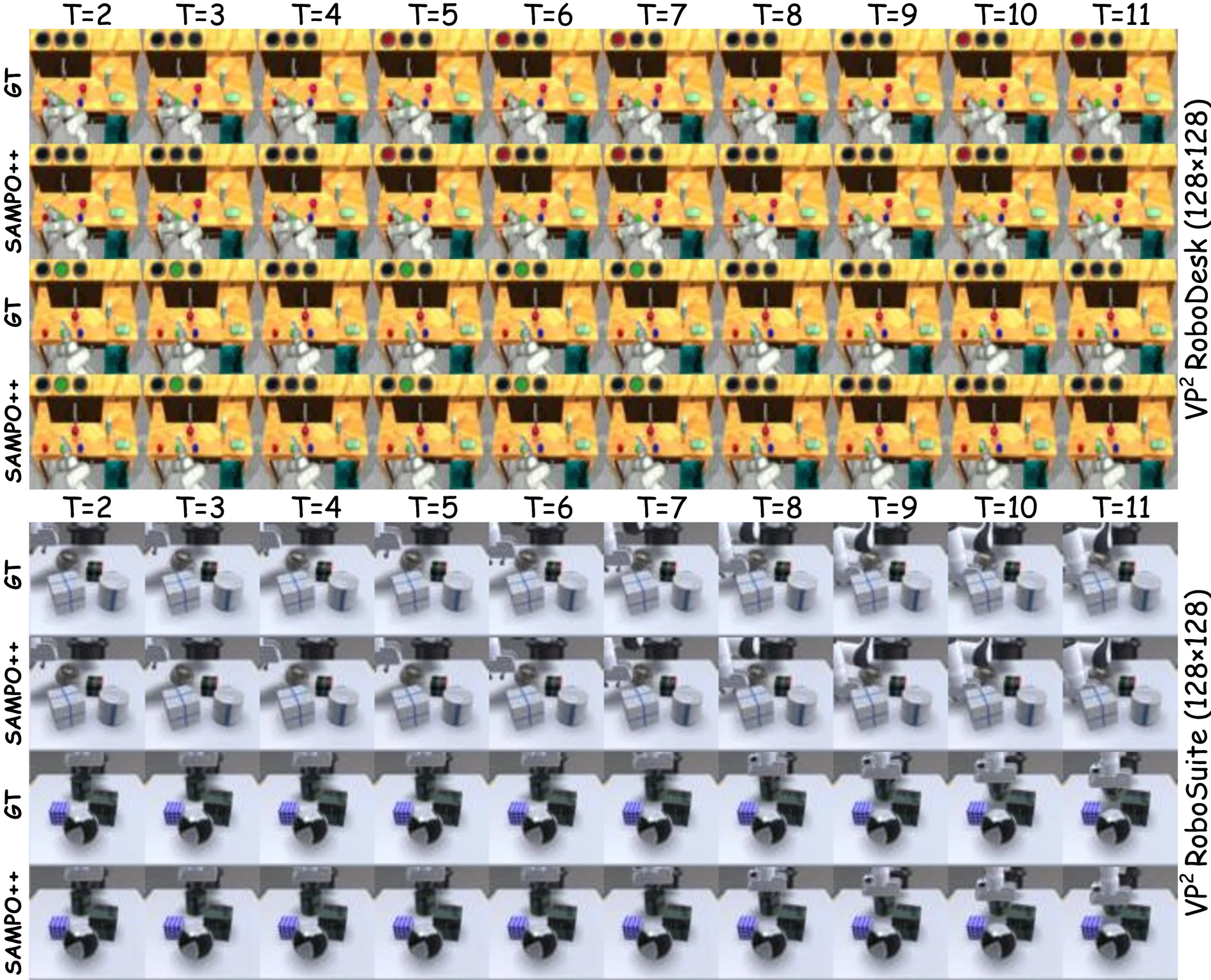
VP2 benchmark
Visual planning examples from RoboDesk and RoboSuite.
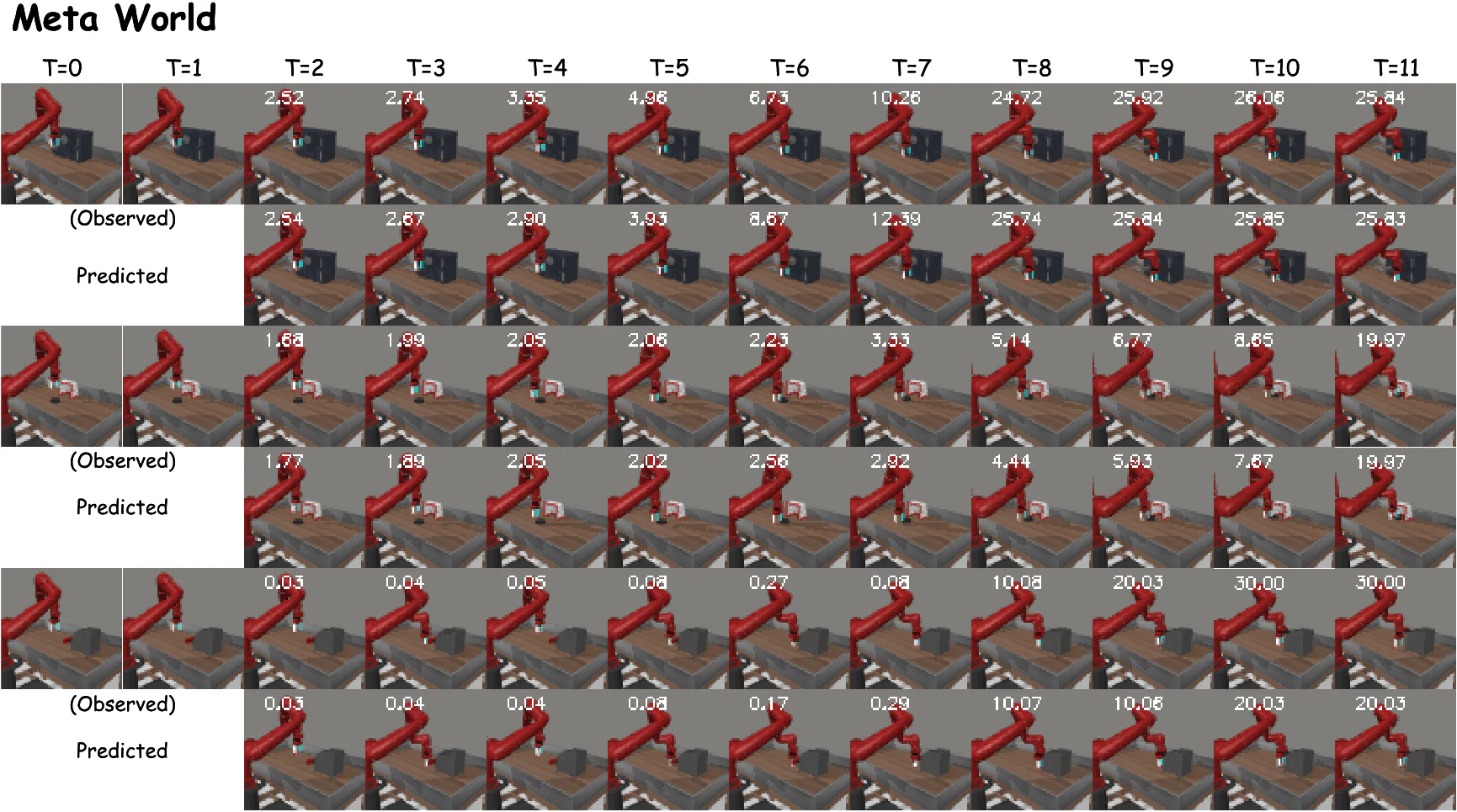
Meta-World tasks
Predicted trajectories align with reward-bearing state changes.
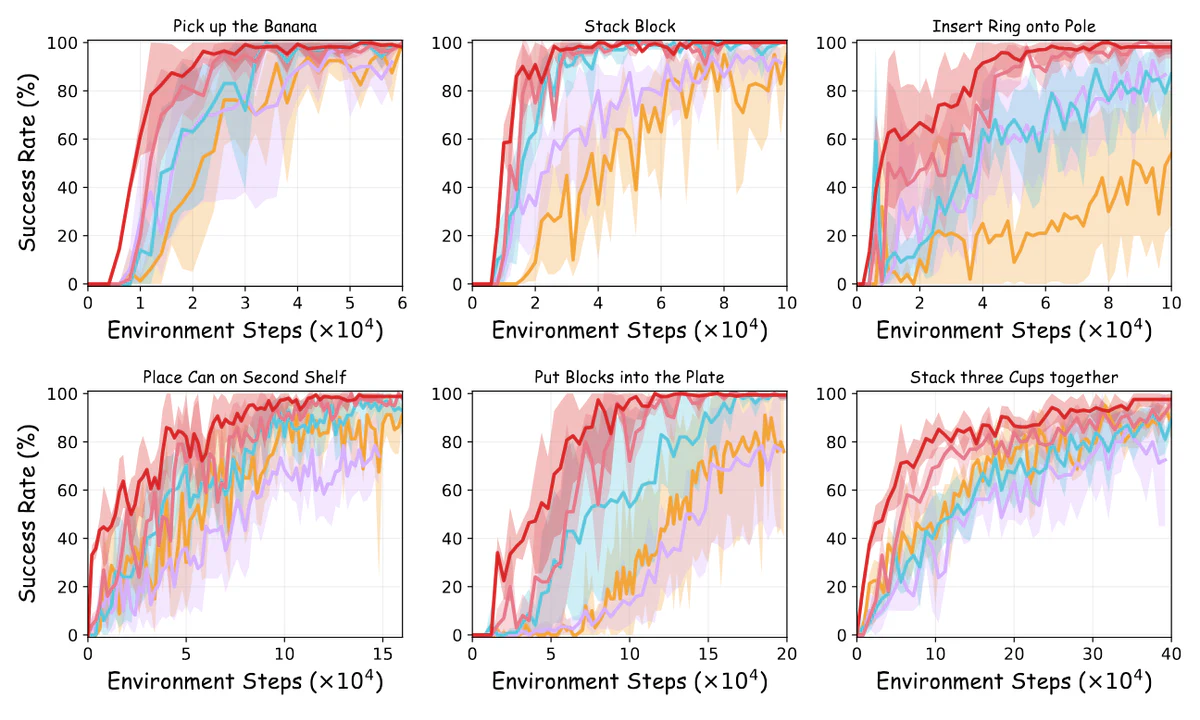
Model-based RL curves
Task-specific success rates across Meta-World control tasks.
Quantitative and ablation summary
Ablations isolate the contributions of continuous latents, ACVF, PC-RoPE, and rollout-aware training.
VLA rollout videos
SAMPO++ acts as a simulator for VLA action prediction. Select a demo to compare the real robot rollout with the predicted video trajectory.
Demo 1 - VLA rollout
Real execution is paired with the predicted future generated by SAMPO++ from VLA action prediction.
Key results
The final quantitative summary highlights the gains in video fidelity, long-horizon stability, and downstream visual planning.
2 -> 28 long-horizon prediction, lower is better.
Maintains stability in extended prediction.
Average downstream visual planning success.
Action-conditioned 64x64 video prediction.
Citation
If you find SAMPO++ useful, please cite:
@article{wang2026sampopp,
  title  = {Unified Temporal Autoregression and Scale-Wise Flow Matching for Embodied World Models},
  author = {Wang, Sen and Zhou, Sanping and Dong, Huaiyi and Xia, Kun and Hua, Gang and Wang, Le},
  note   = {Preprint},
  year   = {2026}
}